
algo.SPpaths procedure finds the shortest paths between a source and a target node, optionally constrained by cost, path length, and the number of paths to return.
It is designed for efficient and scalable computation of paths in large graphs, using properties like distance, time, or price as weights.
For example, it can be used to find the fastest driving route between two cities, the cheapest shipping option in a logistics network, or the shortest communication path in a computer network.
Syntax
Parameters
Returns
Examples
Let’s take this Road Network Graph as an example: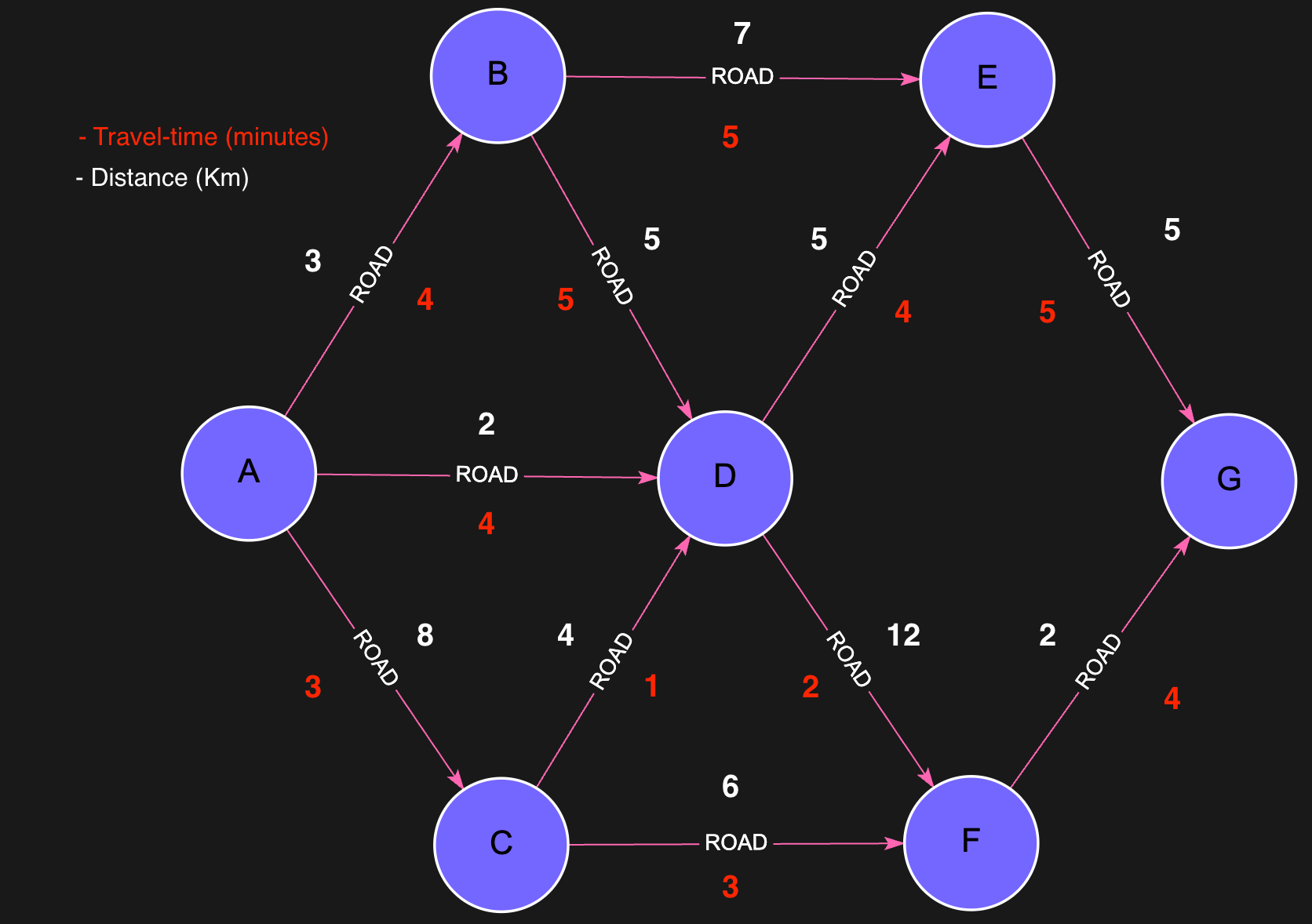
Example: Shortest Path by Distance from City A to City G
Expected Result:
Example: Bounded Cost Path from City A to City G
Expected Result:
Frequently Asked Questions
What is the difference between weightProp and costProp?
What is the difference between weightProp and costProp?
weightProp is the property the algorithm minimizes (e.g. distance). costProp is a separate property used as a constraint — you can set
maxCost to exclude paths whose total cost exceeds a threshold.How do I get all shortest paths instead of just one?
How do I get all shortest paths instead of just one?
Set
pathCount: 0 to return all shortest paths. The default is 1 (single shortest path). You can also set a specific number like pathCount: 5 to get up to 5 paths.Can I search for paths in both directions?
Can I search for paths in both directions?
Yes. Set
relDirection to 'both' to traverse relationships regardless of direction. Other options are 'outgoing' (default) and 'incoming'.When should I use algo.SPpaths vs algo.SSpaths?
When should I use algo.SPpaths vs algo.SSpaths?
Use algo.SPpaths when you have a specific source and target node. Use algo.SSpaths when you want shortest paths from one source to all reachable destinations.
What happens if no path exists between source and target?
What happens if no path exists between source and target?
The procedure returns no results (empty result set). No error is raised.