> ## Documentation Index
> Fetch the complete documentation index at: https://new.docs.falkordb.com/llms.txt
> Use this file to discover all available pages before exploring further.
# Functions
> Complete reference for Cypher functions in FalkorDB including predicate, scalar, aggregating, list, mathematical, string, type conversion, node, path, and vector functions.
This section contains information on all supported functions from the Cypher query language.
* [Predicate functions](#predicate-functions)
* [Scalar functions](#scalar-functions)
* [Aggregating functions](#aggregating-functions)
* [List functions](#list-functions)
* [Mathematical operators](#mathematical-operators)
* [Mathematical functions](#mathematical-functions)
* [Trigonometric functions](#trigonometric-functions)
* [String functions](#string-functions)
* [Point functions](#point-functions)
* [Type conversion functions](#type-conversion-functions)
* [Node functions](#node-functions)
* [Path functions](#path-functions)
* [Vector functions](#vector-functions)
## Predicate functions
| Function | Description |
| --------------------------------------------------------------------------------- | :--------------------------------------------------------------------------------------------------------------------------------------------------------------------------------------------------------------------------------------------------------------------------------------------- |
| [all(*var* IN *list* WHERE *predicate*)](#existential-comprehension-functions) | Returns true when *predicate* holds true for all elements in *list* |
| [any(*var* IN *list* WHERE *predicate*)](#existential-comprehension-functions) | Returns true when *predicate* holds true for at least one element in *list* |
| exists(*entity.property*) | Returns true when the specified property exists on a given node or relationship
**Note:** Graph patterns such as `exists((n)-[]->())` are not supported. To filter by graph patterns, use [pattern predicates](/cypher/where#pattern-predicates) directly in the `WHERE` clause instead |
| isEmpty(*list*\|*map*\|*string*) | Returns true if the input list or map contains no elements or if the input string contains no characters
Returns null when the input evaluates to null |
| [none(*var* IN *list* WHERE *predicate*)](#existential-comprehension-functions) | Returns true when *predicate* holds false for all elements in *list* |
| [single(*var* IN *list* WHERE *predicate*)](#existential-comprehension-functions) | Returns true when *predicate* holds true for exactly one element in *list* |
## Scalar functions
| Function | Description |
| ---------------------------------- | :-------------------------------------------------------------------------------------------------------------------------------------------------------------------------------------------------------------------------------------------------------------- |
| coalesce(*expr*\[, expr...]) | Returns the evaluation of the first argument that evaluates to a non-null value
Returns null when all arguments evaluate to null |
| endNode(*relationship*) | Returns the destination node of a relationship
Returns null when *relationship* evaluates to null |
| hasLabels(*node*, *labelsList*) \* | Returns true when *node* contains all labels in *labelsList*, otherwise false
Return true when *labelsList* evaluates to an empty list |
| id(*node*\|*relationship*) | Returns the internal ID of a node or relationship (which is not immutable) |
| labels(*node*) | Returns a list of strings: all labels of *node*
Returns null when *node* evaluates to null |
| properties(*expr*) | When *expr* is a node or relationship: Returns a map containing all the properties of the given node or relationship
When *expr* evaluates to a map: Returns *expr* unchanged
Returns null when *expr* evaluates to null |
| randomUUID() | Returns a random UUID (Universal Unique IDentifier) |
| startNode(*relationship*) | Returns the source node of a relationship
Returns null when *relationship* evaluates to null |
| timestamp() | Returns the current system timestamp (milliseconds since epoch) |
| type(*relationship*) | Returns a string: the type of *relationship*
Returns null when *relationship* evaluates to null |
| typeOf(*expr*) \* | Returns a string: the type of a literal, an expression's evaluation, an alias, a node's property, or a relationship's property
Return value is one of `Map`, `String`, `Integer`, `Boolean`, `Float`, `Node`, `Edge`, `List`, `Path`, `Point`, or `Null` |
| prev(*expr*) \* | Stores the previous value and returns it on the next call; returns `null` on the first call. Useful for variable-length traversal filtering of edges based on the prior value. |
\* FalkorDB-specific extensions to Cypher
## Aggregating functions
| Function | Description |
| ------------------------------------ | :---------------------------------------------------------------------------------------------------------------------------------------------------------------------- |
| avg(*expr*) | Returns the average of a set of numeric values. null values are ignored
Returns null when *expr* has no evaluations |
| collect(*expr*) | Returns a list containing all non-null elements which evaluated from a given expression |
| count(*expr*\|\*) | When argument is *expr*: returns the number of non-null evaluations of *expr*
When argument is `*`: returns the total number of evaluations (including nulls) |
| max(*expr*) | Returns the maximum value in a set of values (taking into account type ordering). null values are ignored
Returns null when *expr* has no evaluations |
| min(*expr*) | Returns the minimum value in a set of values (taking into account type ordering). null values are ignored
Returns null when *expr* has no evaluations |
| percentileCont(*expr*, *percentile*) | Returns a linear-interpolated percentile (between 0.0 and 1.0) over a set of numeric values. null values are ignored
Returns null when *expr* has no evaluations |
| percentileDisc(*expr*, *percentile*) | Returns a nearest-value percentile (between 0.0 and 1.0) over a set of numeric values. null values are ignored
Returns null when *expr* has no evaluations |
| stDev(*expr*) | Returns the sample standard deviation over a set of numeric values. null values are ignored
Returns null when *expr* has no evaluations |
| stDevP(*expr*) | Returns the population standard deviation over a set of numeric values. null values are ignored
Returns null when *expr* has no evaluations |
| sum(*expr*) | Returns the sum of a set of numeric values. null values are ignored
Returns 0 when *expr* has no evaluations |
## List functions
| Function | Description |
| -------------------------------------------------------------------- | :------------------------------------------------------------------------------------------------------------------------------------------------------------------------------------------------------------------------------------------------------------------------------------------------------------------------------------------------------------------------------------------------------------------------------------------------------------------------------------------------------------------------------------------------------------------------------------------------------------------------------------------------------------------------------------------------------------------------------------------------------------------------------------------------------------------------------------------------------------------------------------------------------------------------- |
| head(*expr*) | Returns the first element of a list
Returns null when *expr* evaluates to null or an empty list |
| keys(*expr*) | Returns a list of strings: all key names for given map or all property names for a given node or edge
Returns null when *expr* evaluates to null |
| last(*expr*) | Returns the last element of a list
Returns null when *expr* evaluates to null or an empty list |
| list.dedup(*list*) \* | Given a list, returns a similar list after removing duplicate elements
Order is preserved, duplicates are removed from the end of the list
Returns null when *list* evaluates to null
Emit an error when *list* does not evaluate to a list or to null |
| list.insert(*list*, *idx*, *val*\[, *dups* = TRUE]) \* | Given a list, returns a list after inserting a given value at a given index
*idx* is 0-based when non-negative, or from the end of the list when negative
Returns null when *list* evaluates to null
Returns *list* when *val* evaluates to null
Returns *list* when *idx* evaluates to an integer not in \[-NumItems-1 .. NumItems]
When *dups* evaluates to FALSE: returns *list* when *val* evaluates to a value that is already an element of *list*
Emit an error when *list* does not evaluate to a list or to null
Emit an error when *idx* does not evaluate to an integer
Emit an error when *dups*, if specified, does not evaluate to a Boolean |
| list.insertListElements(*list*, *list2*, *idx*\[, *dups* = TRUE]) \* | Given a list, returns a list after inserting the elements of a second list at a given index
*idx* is 0-based when non-negative, or from the end of the list when negative
Returns null when *list* evaluates to null
Returns *list* when *list2* evaluates to null
Returns *list* when *idx* evaluates to an integer not in \[-NumItems-1 .. NumItems]
When *dups* evaluates to FALSE: If an element of *list2* evaluates to an element of *list* it would be skipped; If multiple elements of *list2* evaluate to the same value - this value would be inserted at most once to *list*
Emit an error when *list* does not evaluate to a list or to null
Emit an error when *list2* does not evaluate to a list or to null
Emit an error when *idx* does not evaluate to an integer
Emit an error when *dups*, if specified, does not evaluate to a Boolean |
| list.remove(*list*, *idx*\[, *count* = 1]) \* | Given a list, returns a list after removing a given number of consecutive elements (or less, if the end of the list has been reached). starting at a given index.
*idx* is 0-based when non-negative, or from the end of the list when negative
Returns *null* when *list* evaluates to null
Returns *list* when *idx* evaluates to an integer not in \[-NumItems .. NumItems-1]
Returns *list* when *count* evaluates to a non-positive integer
Emit an error when *list* does not evaluate to a list or to null
Emit an error when *idx* does not evaluate to an integer
Emit an error when *count*, if specified, does not evaluate to an integer |
| list.sort(*list*\[, *ascending* = TRUE]) \* | Given a list, returns a list with similar elements, but sorted (inversely-sorted if *ascending* is evaluated to FALSE)
Returns null when *list* evaluates to null
Emit an error when *list* does not evaluate to a list or to null
Emit an error when *ascending*, if specified, does not evaluate to a Boolean |
| range(*first*, *last*\[, *step* = 1]) | Returns a list of integers in the range of \[start, end]. *step*, an optional integer argument, is the increment between consecutive elements |
| size(*expr*) | Returns the number of elements in a list
Returns null with *expr* evaluates to null |
| tail(*expr*) | Returns a sublist of a list, which contains all its elements except the first
Returns an empty list when *expr* contains less than 2 elements.
Returns null when *expr* evaluates to null |
| [reduce(...)](#reduce) | Returns a scalar produced by evaluating an expression against each list member |
\* FalkorDB-specific extensions to Cypher
## Mathematical operators
| Function | Description |
| -------- | :------------------------------------------------------- |
| + | Add two values |
| - | Subtract second value from first |
| \* | Multiply two values |
| / | Divide first value by the second |
| ^ | Raise the first value to the power of the second |
| % | Perform modulo division of the first value by the second |
## Mathematical functions
| Function | Description |
| -------------------------- | :---------------------------------------------------------------------------------------------------------------------------------------------------------------------------------------------------------------------------------------------------- |
| abs(*expr*) | Returns the absolute value of a numeric value
Returns null when *expr* evaluates to null |
| ceil(*expr*) \*\* | When *expr* evaluates to an integer: returns its evaluation
When *expr* evaluates to floating point: returns a floating point equals to the smallest integer greater than or equal to *expr*
Returns null when *expr* evaluates to null |
| e() | Returns the constant *e*, the base of the natural logarithm |
| exp(*expr*) | Returns *e*^*expr*, where *e* is the base of the natural logarithm
Returns null when *expr* evaluates to null |
| floor(*expr*) \*\* | When *expr* evaluates to an integer: returns its evaluation
When *expr* evaluates to a floating point: returns a floating point equals to the greatest integer less than or equal to *expr*
Returns null when *expr* evaluates to null |
| log(*expr*) | Returns the natural logarithm of a numeric value
Returns nan when *expr* evaluates to a negative numeric value, -inf when *expr* evaluates to 0, and null when *expr* evaluates to null |
| log10(*expr*) | Returns the base-10 logarithm of a numeric value
Returns nan when *expr* evaluates to a negative numeric value, -inf when *expr* evaluates to 0, and null when *expr* evaluates to null |
| pow(*base*, *exponent*) \* | Returns *base* raised to the power of *exponent* (equivalent to *base*^*exponent*)
Returns null when either evaluates to null |
| rand() | Returns a random floating point in the range \[0,1] |
| round(*expr*) \*\* \*\*\* | When *expr* evaluates to an integer: returns its evaluation
When *expr* evaluates to a floating point: returns a floating point equals to the integer closest to *expr*
Returns null when *expr* evaluates to null |
| sign(*expr*) | Returns the signum of a numeric value: 0 when *expr* evaluates to 0, -1 when *expr* evaluates to a negative numeric value, and 1 when *expr* evaluates to a positive numeric value
Returns null when *expr* evaluates to null |
| sqrt(*expr*) | Returns the square root of a numeric value
Returns nan when *expr* evaluates to a negative value and null when *expr* evaluates to null |
\* FalkorDB-specific extensions to Cypher
\*\* FalkorDB-specific behavior: to avoid possible loss of precision, when *expr* evaluates to an integer - the result is an integer as well
\*\*\* FalkorDB-specific behavior: tie-breaking method is "half away from zero"
## Trigonometric functions
| Function | Description |
| --------------------- | :------------------------------------------------------------------------------------------------------------------------------------------------------------------------------------------------------------------- |
| acos(*expr*) | Returns the arccosine, in radians, of a numeric value
Returns nan when *expr* evaluates to a numeric value not in \[-1, 1] and null when *expr* evaluates to null |
| asin(*expr*) | Returns the arcsine, in radians, of a numeric value
Returns nan when *expr* evaluates to a numeric value not in \[-1, 1] and null when *expr* evaluates to null |
| atan(*expr*) | Returns the arctangent, in radians, of a numeric value
Returns null when *expr* evaluates to null |
| atan2(*expr*, *expr*) | Returns the 2-argument arctangent, in radians, of a pair of numeric values (Cartesian coordinates)
Returns 0 when both expressions evaluate to 0
Returns null when either expression evaluates to null |
| cos(*expr*) | Returns the cosine of a numeric value that represents an angle in radians
Returns null when *expr* evaluates to null |
| cot(*expr*) | Returns the cotangent of a numeric value that represents an angle in radians
Returns inf when *expr* evaluates to 0 and null when *expr* evaluates to null |
| degrees(*expr*) | Converts a numeric value from radians to degrees
Returns null when *expr* evaluates to null |
| haversin(*expr*) | Returns half the versine of a numeric value that represents an angle in radians
Returns null when *expr* evaluates to null |
| pi() | Returns the mathematical constant *pi* |
| radians(*expr*) | Converts a numeric value from degrees to radians
Returns null when *expr* evaluates to null |
| sin(*expr*) | Returns the sine of a numeric value that represents an angle in radians
Returns null when *expr* evaluates to null |
| tan(*expr*) | Returns the tangent of a numeric value that represents an angle in radians
Returns null when *expr* evaluates to null |
## String functions
| Function | Description |
| ----------------------------------------------------- | :-------------------------------------------------------------------------------------------------------------------------------------------------------------------------------------------------------------------------------------------------------------------------------------------------------------------------------------------------------------------------------------------------------------------------------------------------------------------------------------------------------------------------------- |
| left(*str*, *len*) | Returns a string containing the *len* leftmost characters of *str*
Returns null when *str* evaluates to null, otherwise emit an error if *len* evaluates to null |
| lTrim(*str*) | Returns *str* with leading whitespace removed
Returns null when *str* evaluates to null |
| replace(*str*, *search*, *replace*) | Returns *str* with all occurrences of *search* replaced with *replace*
Returns null when any argument evaluates to null |
| reverse(*str*) | Returns a string in which the order of all characters in *str* are reversed
Returns null when *str* evaluates to null |
| right(*str*, *len*) | Returns a string containing the *len* rightmost characters of *str*
Returns null when *str* evaluates to null, otherwise emit an error if *len* evaluates to null |
| rTrim(*str*) | Returns *str* with trailing whitespace removed
Returns null when *str* evaluates to null |
| split(*str*, *delimiter*) | Returns a list of strings from splitting *str* by *delimiter*
Returns null when any argument evaluates to null |
| string.join(*strList*\[, *delimiter* = '']) \* | Returns a concatenation of a list of strings using a given delimiter
Returns null when *strList* evaluates to null
Returns null when *delimiter*, if specified, evaluates to null
Emit an error when *strList* does not evaluate to a list or to null
Emit an error when an element of *strList* does not evaluate to a string
Emit an error when *delimiter*, if specified, does not evaluate to a string or to null |
| string.matchRegEx(*str*, *regex*) \* | Given a string and a regular expression, returns a list of all matches and matching regions
Returns an empty list when *str* evaluates to null
Returns an empty list when *regex* evaluates to null
Emit an error when *str* does not evaluate to a string or to null
Emit an error when *regex* does not evaluate to a valid regex string or to null |
| string.replaceRegEx(*str*, *regex*, *replacement*) \* | Given a string and a regular expression, returns a string after replacing each regex match with a given replacement
Returns null when *str* evaluates to null
Returns null when *regex* evaluates to null
Returns null when *replacement* evaluates to null
Emit an error when *str* does not evaluate to a string or to null
Emit an error when *regex* does not evaluate to a valid regex string or to null
Emit an error when *replacement* does not evaluate to a string or to null |
| substring(*str*, *start*\[, *len*]) | When *len* is specified: returns a substring of *str* beginning with a 0-based index *start* and with length *len*
When *len* is not specified: returns a substring of *str* beginning with a 0-based index *start* and extending to the end of *str*
Returns null when *str* evaluates to null
Emit an error when *start* or *len* evaluate to null |
| toLower(*str*) | Returns *str* in lowercase
Returns null when *str* evaluates to null |
| toJSON(*expr*) \* | Returns a [JSON representation](#json-format) of a value
Returns null when *expr* evaluates to null |
| toUpper(*str*) | Returns *str* in uppercase
Returns null when *str* evaluates to null |
| trim(*str*) | Returns *str* with leading and trailing whitespace removed
Returns null when *str* evaluates to null |
| size(*str*) | Returns the number of characters in *str*
Returns null when *str* evaluates to null |
| [intern(*str*)](#intern) | Returns a deduplicated, memory-efficient representation of *str*
Returns null when *str* evaluates to null |
## Point functions
| Function | Description |
| ---------------------------- | :------------------------------------------------------------------------------------------------------------ |
| [point(*map*)](#point) | Returns a Point representing a lat/lon coordinates |
| distance(*point1*, *point2*) | Returns the distance in meters between the two given points
Returns null when either evaluates to null |
## Type conversion functions
| Function | Description |
| ---------------------------- | :-------------------------------------------------------------------------------------------------------------------------------------------------------------------------------------------------------------------------------------------------------------------------------------------------------------------------------------------------------------------- |
| toBoolean(*expr*) | Returns a Boolean when *expr* evaluates to a Boolean
Converts a string to Boolean (`"true"` (case insensitive) to true, `"false"` (case insensitive) to false, any other value to null)
Converts an integer to Boolean (0 to `false`, any other values to `true`)
Returns null when *expr* evaluates to null
Emit an error on other types |
| toBooleanList(*exprList*) | Converts a list to a list of Booleans. Each element in the list is converted using toBooleanOrNull() |
| toBooleanOrNull(*expr*) | Returns a Boolean when *expr* evaluates to a Boolean
Converts a string to Boolean (`"true"` (case insensitive) to true, `"false"` (case insensitive) to false, any other value to null)
Converts an integer to Boolean (0 to `false`, any other values to `true`)
Returns null when *expr* evaluates to null
Returns null for other types |
| toFloat(*expr*) | Returns a floating point when *expr* evaluates to a floating point
Converts an integer to a floating point
Converts a string to a floating point or null
Returns null when *expr* evaluates to null
Emit an error on other types |
| toFloatList(*exprList*) | Converts a list to a list of floating points. Each element in the list is converted using toFloatOrNull() |
| toFloatOrNull(*expr*) | Returns a floating point when *expr* evaluates to a floating point
Converts an integer to a floating point
Converts a string to a floating point or null
Returns null when *expr* evaluates to null
Returns null for other types |
| toInteger(*expr*) \* | Returns an integer when *expr* evaluates to an integer
Converts a floating point to integer
Converts a string to an integer or null
Converts a Boolean to an integer (false to 0, true to 1) Returns null when *expr* evaluates to null
Emit an error on other types |
| toIntegerList(*exprList*) \* | Converts a list to a list of integer values. Each element in the list is converted using toIntegerOrNull() |
| toIntegerOrNull(*expr*) \* | Returns an integer when *expr* evaluates to an integer
Converts a floating point to integer
Converts a string to an integer or null
Converts a Boolean to an integer (false to 0, true to 1) Returns null when *expr* evaluates to null
Returns null for other types |
| toString(*expr*) | Returns a string when *expr* evaluates to a string
Converts an integer, float, Boolean, string, or point to a string representation
Returns null when *expr* evaluates to null
Emit an error on other types |
| toStringList(*exprList*) | Converts a list to a list of strings. Each element in the list is converted using toStringOrNull() |
| toStringOrNull(*expr*) | Returns a string when *expr* evaluates to a string
Converts an integer, float, Boolean, string, or point to a string representation
Returns null when *expr* evaluates to null
Returns null for other types |
\* FalkorDB-specific behavior: rounding method when converting a floating point to an integer is "toward negative infinity (floor)"
## Node functions
| Function | Description |
| -------------------------------------------------------------------------------------- | :---------------------------------------------------------------------------------------------------------------------------------------------------------------------------------------------------------------------------------------------------------------------------------------- |
| indegree(*node* \[, *reltype* ...]) \*
indegree(*node* \[, *reltypeList*]) \* | When no relationship types are specified: Returns the number of *node*'s incoming edges
When one or more relationship types are specified: Returns the number of *node's* incoming edges with one of the given relationship types
Return null when *node* evaluates to null |
| outdegree(*node* \[, *reltype* ...]) \*
outdegree(*node* \[, *reltypeList*]) \* | When no relationship types are specified: Returns the number of *node*'s outgoing edges
When one or more relationship types are specified: Returns the number of *node's* outgoing edges with one of the given relationship types
Return null when *node* evaluates to null |
\* FalkorDB-specific extensions to Cypher
## Path functions
| Function | Description |
| ------------------------------------------------- | :-------------------------------------------------------------------------------------------------------- |
| nodes(*path*) | Returns a list containing all the nodes in *path*
Returns null if *path* evaluates to null |
| relationships(*path*) | Returns a list containing all the relationships in *path*
Returns null if *path* evaluates to null |
| length(*path*) | Return the length (number of edges) of *path*
Returns null if *path* evaluates to null |
| [shortestPath(...)](#about-path-functions) \* | Return the shortest path that resolves the given pattern |
| [allShortestPaths(...)](#about-path-functions) \* | Returns all the shortest paths between a pair of entities |
\* FalkorDB-specific extensions to Cypher
## Vector functions
| Function | Description |
| ----------------------------------------- | :------------------------------------------------------------------------------------- |
| vecf32(*array*) | Creates a new float 32 vector
all elements of input array must be of type float |
| vec.euclideanDistance(*vector*, *vector*) | Returns the Euclidean distance between the two input vectors |
| vec.cosineDistance(*vector*, *vector*) | Returns the Cosine distance between the two input vectors |
### List comprehensions
List comprehensions are a syntactical construct that accepts an array and produces another based on the provided map and filter directives.
They are a common construct in functional languages and modern high-level languages. In Cypher, they use the syntax:
```sh theme={null}
[element IN array WHERE condition | output elem]
```
* `array` can be any expression that produces an array: a literal, a property reference, or a function call.
* `WHERE condition` is an optional argument to only project elements that pass a certain criteria. If omitted, all elements in the array will be represented in the output.
* `| output elem` is an optional argument that allows elements to be transformed in the output array. If omitted, the output elements will be the same as their corresponding inputs.
The following query collects all paths of any length, then for each produces an array containing the `name` property of every node with a `rank` property greater than 10:
```cypher theme={null}
MATCH p=()-[*]->() RETURN [node IN nodes(p) WHERE node.rank > 10 | node.name]
```
#### Existential comprehension functions
The functions `any()`, `all()`, `single()` and `none()` use a simplified form of the list comprehension syntax and return a boolean value.
```cypher theme={null}
any(element IN array WHERE condition)
```
They can operate on any form of input array, but are particularly useful for path filtering. The following query collects all paths of any length in which all traversed edges have a weight less than 3:
```sh theme={null}
MATCH p=()-[*]->() WHERE all(edge IN relationships(p) WHERE edge.weight < 3) RETURN p
```
### Pattern comprehensions
Pattern comprehensions are a method of producing a list composed of values found by performing the traversal of a given graph pattern.
The following query returns the name of a `Person` node and a list of all their friends' ages:
```cypher theme={null}
MATCH (n:Person)
RETURN
n.name,
[(n)-[:FRIEND_OF]->(f:Person) | f.age]
```
Optionally, a `WHERE` clause may be embedded in the pattern comprehension to filter results. In this query, all friends' ages will be gathered for friendships that started before 2010:
```cypher theme={null}
MATCH (n:Person)
RETURN
n.name,
[(n)-[e:FRIEND_OF]->(f:Person) WHERE e.since < 2010 | f.age]
```
### CASE WHEN
The case statement comes in two variants. Both accept an input argument and evaluates it against one or more expressions. The first `WHEN` argument that specifies a value matching the result will be accepted, and the value specified by the corresponding `THEN` keyword will be returned.
Optionally, an `ELSE` argument may also be specified to indicate what to do if none of the `WHEN` arguments match successfully.
In its simple form, there is only one expression to evaluate and it immediately follows the `CASE` keyword:
```cypher theme={null}
MATCH (n)
RETURN
CASE n.title
WHEN 'Engineer' THEN 100
WHEN 'Scientist' THEN 80
ELSE n.privileges
END
```
In its generic form, no expression follows the `CASE` keyword. Instead, each `WHEN` statement specifies its own expression:
```cypher theme={null}
MATCH (n)
RETURN
CASE
WHEN n.age < 18 THEN '0-18'
WHEN n.age < 30 THEN '18-30'
ELSE '30+'
END
```
#### Reduce
The `reduce()` function accepts a starting value and updates it by evaluating an expression against each element of the list:
```cypher theme={null}
RETURN reduce(sum = 0, n IN [1,2,3] | sum + n)
```
`sum` will successively have the values 0, 1, 3, and 6, with 6 being the output of the function call.
### Intern
The `intern()` function expects a single string argument:
```cypher theme={null}
"CREATE (:A {v:intern('VERY LONG STRING')})"
```
This function deduplicates the input string by storing a single internal copy across the database.
It is especially useful for repeated string values—like country names, email domains, or tags—in large graphs.
Interned strings can be stored as node or relationship properties, and behave identically to regular strings in queries,
with the added benefit of reduced memory usage.
### Point
The `point()` function expects one map argument of the form:
```cypher theme={null}
RETURN point({latitude: lat_value, longitude: lon_val})
```
The key names `latitude` and `longitude` are case-sensitive.
The point constructed by this function can be saved as a node/relationship property or used within the query, such as in a `distance` function call.
### About Path Functions
The following graph:
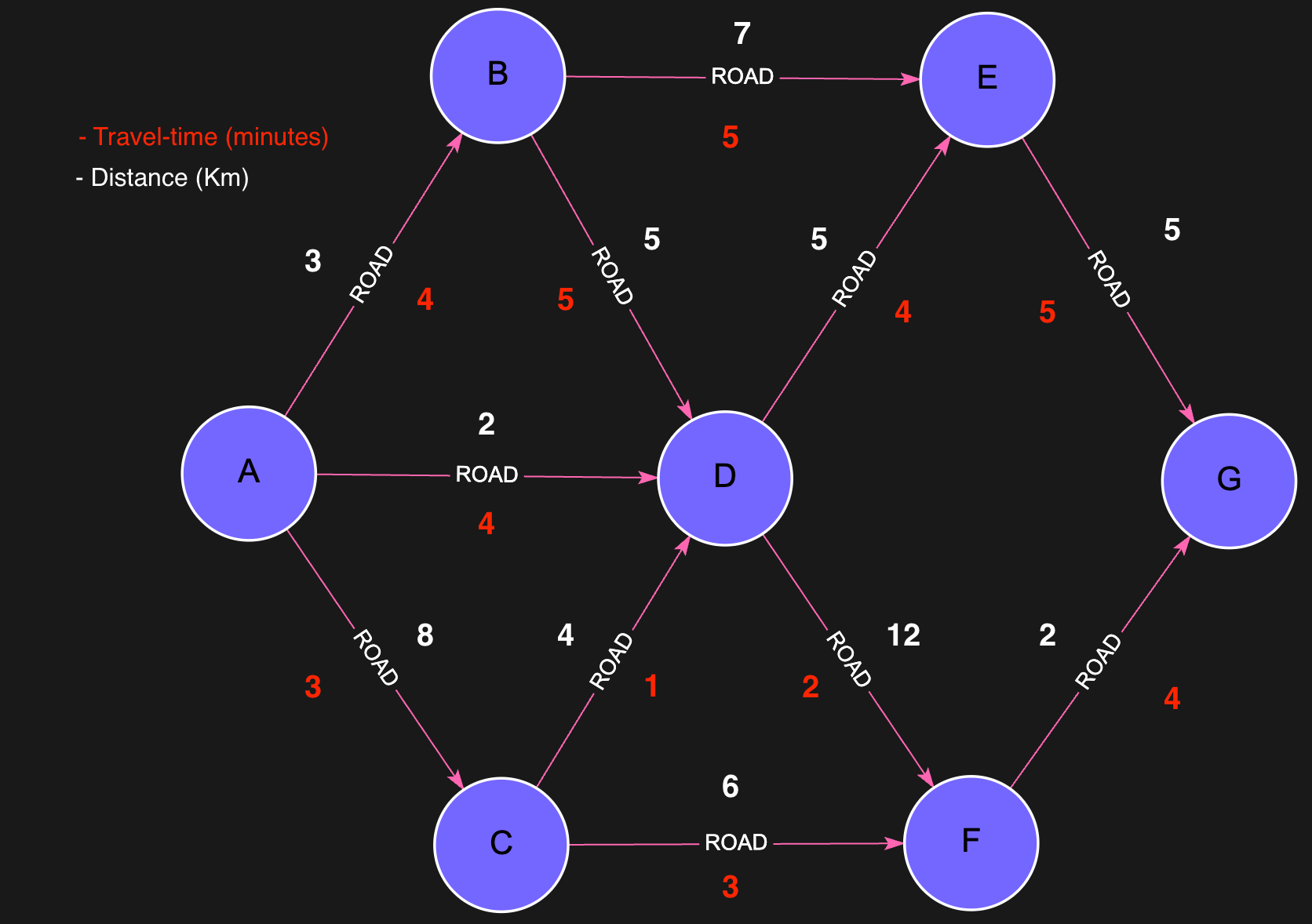 represents a road network with 7 cities (A, B, C, and so on) and 11 one-way roads. Each road has a distance (say, in kilometers) and trip time (say, in minutes).
#### shortestPath
`shortestPath` returns one of the shortest paths. If there is more than one, only one is retrieved.
The sole `shortestPath` argument is a traversal pattern. This pattern's endpoints must be resolved prior to the function call, and no property filters may be introduced in the pattern. The relationship pattern may specify any number of relationship types (including zero) to be considered. If a minimum number of edges to traverse is specified, it may only be 0 or 1, while any number may be used for the maximum. If 0 is specified as the minimum, the source node will be included in the returned path. If no shortest path can be found, NULL is returned.
Example Usage: Find the shortest path (by number of roads) from A to G
```bash theme={null}
$ GRAPH.QUERY g "MATCH (a:City{name:'A'}),(g:City{name:'G'}) WITH shortestPath((a)-[*]->(g)) as p RETURN length(p), [n in nodes(p) | n.name] as pathNodes"
1) 1) "length(p)"
2) "pathNodes"
2) 1) 1) (integer) 3
2) "[A, D, F, G]"
```
represents a road network with 7 cities (A, B, C, and so on) and 11 one-way roads. Each road has a distance (say, in kilometers) and trip time (say, in minutes).
#### shortestPath
`shortestPath` returns one of the shortest paths. If there is more than one, only one is retrieved.
The sole `shortestPath` argument is a traversal pattern. This pattern's endpoints must be resolved prior to the function call, and no property filters may be introduced in the pattern. The relationship pattern may specify any number of relationship types (including zero) to be considered. If a minimum number of edges to traverse is specified, it may only be 0 or 1, while any number may be used for the maximum. If 0 is specified as the minimum, the source node will be included in the returned path. If no shortest path can be found, NULL is returned.
Example Usage: Find the shortest path (by number of roads) from A to G
```bash theme={null}
$ GRAPH.QUERY g "MATCH (a:City{name:'A'}),(g:City{name:'G'}) WITH shortestPath((a)-[*]->(g)) as p RETURN length(p), [n in nodes(p) | n.name] as pathNodes"
1) 1) "length(p)"
2) "pathNodes"
2) 1) 1) (integer) 3
2) "[A, D, F, G]"
```
 #### allShortestPaths
All `allShortestPaths` results have, by definition, the same length (number of roads).
Examples Usage: Find all the shortest paths (by number of roads) from A to G
```bash theme={null}
$ GRAPH.QUERY g "MATCH (a:City{name:'A'}),(g:City{name:'G'}) WITH a,g MATCH p=allShortestPaths((a)-[*]->(g)) RETURN length(p), [n in nodes(p) | n.name] as pathNodes"
1) 1) "length(p)"
2) "pathNodes"
2) 1) 1) (integer) 3
2) "[A, D, F, G]"
2) 1) (integer) 3
2) "[A, C, F, G]"
3) 1) (integer) 3
2) "[A, D, E, G]"
4) 1) (integer) 3
2) "[A, B, E, G]"
```
Using the unbounded traversal pattern `(a:City{name:'A'})-[*]->(g:City{name:'G'})`, FalkorDB traverses all possible paths from A to G. `ORDER BY length(p) LIMIT 5` ensures that you collect only \[up to 5 shortest paths (minimal number of relationships). This approach is very inefficient because all possible paths would have to be traversed. Ideally, you would want to abort some traversals as soon as you are sure they would not result in the discovery of shorter paths.
### JSON format
`toJSON()` returns the input value in JSON formatting. For primitive data types and arrays, this conversion is conventional. Maps and map projections (`toJSON(node { .prop} )`) are converted to JSON objects, as are nodes and relationships.
The format for a node object in JSON is:
```sh theme={null}
{
"type": "node",
"id": id(int),
"labels": [label(string) X N],
"properties": {
property_key(string): property_value X N
}
}
```
The format for a relationship object in JSON is:
```sh theme={null}
{
"type": "relationship",
"id": id(int),
"relationship": type(string),
"properties": {
property_key(string): property_value X N
}
"start": src_node(node),
"end": dest_node(node)
}
```
### Variable length traverse filtering
Consider a logistics network where:
* Nodes (Warehouse) represent distribution centers.
* Edges (Shipment) represent routes where packages are shipped.
* Each shipment has an increasing priority level.
Imagine a package tracking system where deliveries follow a priority-based routing:
* Each shipment (Shipment) has a priority value (s.priority).
* We want to ensure that package priority never decreases as it moves through the network.
* The query filters paths where the previous shipment (prev(s.priority)) has a lower or equal priority than the current one (s.priority).
```cypher theme={null}
MATCH p=(:Warehouse)-[s:Shipment]->(:Warehouse)
WHERE coalesce(prev(s.priority), s.priority) <= s.priority
RETURN p
```
* `MATCH p=(:Warehouse)-[s:Shipment]->(:Warehouse)`
Finds shipment paths between warehouses.
* `WHERE coalesce(prev(s.priority)) <= s.priority`
Ensures that priority never decreases along the route.
* `RETURN p`
Returns valid paths where shipments maintain or increase priority.
## Frequently Asked Questions
FalkorDB supports **predicate**, **scalar**, **aggregating**, **list**, **mathematical**, **trigonometric**, **string**, **point**, **type conversion**, **node**, **path**, and **vector** functions.
Use the `exists()` predicate function: `WHERE exists(n.email)`. Note that graph pattern existence checks like `exists((n)-[]->())` are not supported — use pattern predicates in WHERE instead.
Use type conversion functions like `toInteger()`, `toFloat()`, `toString()`, and `toBoolean()`. These are especially useful when importing data from CSV where all values start as strings.
The `collect()` aggregation function gathers values into a list. It is the inverse of UNWIND and is useful for grouping related values: `RETURN person.city, collect(person.name) AS residents`.
Yes. FalkorDB provides `vecf32()` for creating 32-bit float vectors and `vecf64()` for 64-bit float vectors. These are used with vector indexes for similarity search operations.
#### allShortestPaths
All `allShortestPaths` results have, by definition, the same length (number of roads).
Examples Usage: Find all the shortest paths (by number of roads) from A to G
```bash theme={null}
$ GRAPH.QUERY g "MATCH (a:City{name:'A'}),(g:City{name:'G'}) WITH a,g MATCH p=allShortestPaths((a)-[*]->(g)) RETURN length(p), [n in nodes(p) | n.name] as pathNodes"
1) 1) "length(p)"
2) "pathNodes"
2) 1) 1) (integer) 3
2) "[A, D, F, G]"
2) 1) (integer) 3
2) "[A, C, F, G]"
3) 1) (integer) 3
2) "[A, D, E, G]"
4) 1) (integer) 3
2) "[A, B, E, G]"
```
Using the unbounded traversal pattern `(a:City{name:'A'})-[*]->(g:City{name:'G'})`, FalkorDB traverses all possible paths from A to G. `ORDER BY length(p) LIMIT 5` ensures that you collect only \[up to 5 shortest paths (minimal number of relationships). This approach is very inefficient because all possible paths would have to be traversed. Ideally, you would want to abort some traversals as soon as you are sure they would not result in the discovery of shorter paths.
### JSON format
`toJSON()` returns the input value in JSON formatting. For primitive data types and arrays, this conversion is conventional. Maps and map projections (`toJSON(node { .prop} )`) are converted to JSON objects, as are nodes and relationships.
The format for a node object in JSON is:
```sh theme={null}
{
"type": "node",
"id": id(int),
"labels": [label(string) X N],
"properties": {
property_key(string): property_value X N
}
}
```
The format for a relationship object in JSON is:
```sh theme={null}
{
"type": "relationship",
"id": id(int),
"relationship": type(string),
"properties": {
property_key(string): property_value X N
}
"start": src_node(node),
"end": dest_node(node)
}
```
### Variable length traverse filtering
Consider a logistics network where:
* Nodes (Warehouse) represent distribution centers.
* Edges (Shipment) represent routes where packages are shipped.
* Each shipment has an increasing priority level.
Imagine a package tracking system where deliveries follow a priority-based routing:
* Each shipment (Shipment) has a priority value (s.priority).
* We want to ensure that package priority never decreases as it moves through the network.
* The query filters paths where the previous shipment (prev(s.priority)) has a lower or equal priority than the current one (s.priority).
```cypher theme={null}
MATCH p=(:Warehouse)-[s:Shipment]->(:Warehouse)
WHERE coalesce(prev(s.priority), s.priority) <= s.priority
RETURN p
```
* `MATCH p=(:Warehouse)-[s:Shipment]->(:Warehouse)`
Finds shipment paths between warehouses.
* `WHERE coalesce(prev(s.priority)) <= s.priority`
Ensures that priority never decreases along the route.
* `RETURN p`
Returns valid paths where shipments maintain or increase priority.
## Frequently Asked Questions
FalkorDB supports **predicate**, **scalar**, **aggregating**, **list**, **mathematical**, **trigonometric**, **string**, **point**, **type conversion**, **node**, **path**, and **vector** functions.
Use the `exists()` predicate function: `WHERE exists(n.email)`. Note that graph pattern existence checks like `exists((n)-[]->())` are not supported — use pattern predicates in WHERE instead.
Use type conversion functions like `toInteger()`, `toFloat()`, `toString()`, and `toBoolean()`. These are especially useful when importing data from CSV where all values start as strings.
The `collect()` aggregation function gathers values into a list. It is the inverse of UNWIND and is useful for grouping related values: `RETURN person.city, collect(person.name) AS residents`.
Yes. FalkorDB provides `vecf32()` for creating 32-bit float vectors and `vecf64()` for 64-bit float vectors. These are used with vector indexes for similarity search operations.