> ## Documentation Index
> Fetch the complete documentation index at: https://new.docs.falkordb.com/llms.txt
> Use this file to discover all available pages before exploring further.
# Weakly Connected Components (WCC)
> Weakly Connected Components (WCC)
## Overview
The Weakly Connected Components (WCC) algorithm identifies groups of nodes connected through any path, disregarding edge directions. In a weakly connected component, every node is reachable from any other node when treating all edges as undirected.
WCC serves as a common algorithm in scenarios such as:
* Community detection
* Data cleaning and preprocessing
* Large-scale network analysis
* Detecting isolated or loosely connected subgraphs
## Algorithm Details
WCC initializes by assigning each node to its own component. It iteratively scans for edges linking nodes across different components and merges them, ignoring the directionality of edges throughout the process. The algorithm terminates when no further merges occur, producing a collection of disjoint connected components.
### Performance
WCC operates with a time complexity of **O(|V| + |E|)**, where:
* **|V|** represents the total number of nodes
* **|E|** represents the total number of edges
This linear complexity makes WCC efficient for large graphs.
## Syntax
```cypher theme={null}
CALL algo.wcc([config])
```
### Parameters
The procedure accepts an optional configuration `Map` with the following parameters:
| Name | Type | Default | Description |
| ------------------- | ----- | ---------------------- | -------------------------------------------------------------------------- |
| `nodeLabels` | Array | All labels | Array of node labels to filter which nodes are included in the computation |
| `relationshipTypes` | Array | All relationship types | Array of relationship types to define which edges are traversed |
### Return Values
The procedure returns a stream of records with the following fields:
| Name | Type | Description |
| ------------- | ------- | ---------------------------------------------------------------- |
| `node` | Node | The node entity included in the component |
| `componentId` | Integer | Identifier of the weakly connected component the node belongs to |
## Examples
Let's take this Social Graph as an example:
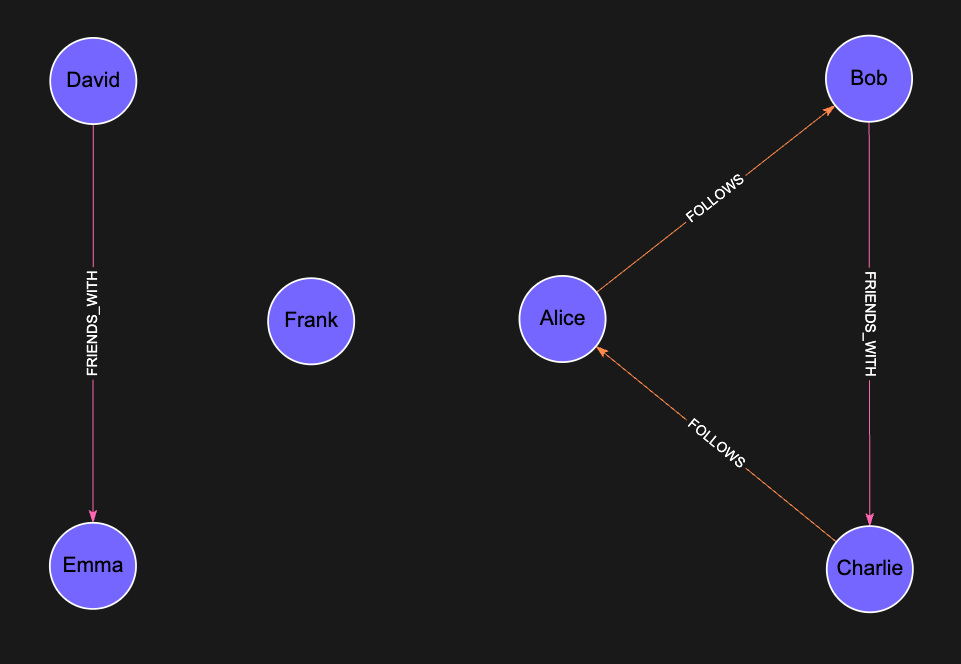 There are 3 different communities in this graph:
* Alice, Bob, Charlie
* David, Emma
* Frank
### Create the Graph
```cypher theme={null}
CREATE
(alice:User {name: 'Alice'}),
(bob:User {name: 'Bob'}),
(charlie:User {name: 'Charlie'}),
(david:User {name: 'David'}),
(emma:User {name: 'Emma'}),
(frank:User {name: 'Frank'}),
(alice)-[:FOLLOWS]->(bob),
(bob)-[:FRIENDS_WITH]->(charlie),
(charlie)-[:FOLLOWS]->(alice),
(david)-[:FRIENDS_WITH]->(emma)
```
### Example: Find isolated communities in a social network
```cypher theme={null}
CALL algo.WCC(null) yield node, componentId
```
#### Expected Results
| node | componentId |
| --------------------------- | ----------- |
| `(:User {name: "Alice"})` | 0 |
| `(:User {name: "Bob"})` | 0 |
| `(:User {name: "Charlie"})` | 0 |
| `(:User {name: "David"})` | 3 |
| `(:User {name: "Emma"})` | 3 |
| `(:User {name: "Frank"})` | 5 |
### Example: Group Communities together into a single list
```cypher theme={null}
CALL algo.WCC(null) yield node, componentId return collect(node.name), componentId
```
#### Expected Results
| collect(node.name) | componentId |
| ----------------------- | ----------- |
| `[David, Emma]` | 3 |
| `[Frank]` | 5 |
| `[Alice, Bob, Charlie]` | 0 |
## Frequently Asked Questions
Use `CALL algo.WCC(null) YIELD node, componentId` or pass a configuration map like `CALL algo.WCC({nodeLabels: ['User']}) YIELD node, componentId`.
No. WCC treats all relationships as **undirected** — it finds components where nodes are reachable through any path regardless of edge direction.
Run `CALL algo.WCC(null) YIELD node, componentId RETURN count(DISTINCT componentId) AS numComponents`.
Use **WCC** to find *disconnected* subgraphs (nodes with no path between them). Use **[CDLP](/algorithms/cdlp)** to detect *densely connected communities* within a connected graph.
WCC runs in **O(V + E)** linear time, making it very efficient even on large graphs with millions of nodes and edges.
There are 3 different communities in this graph:
* Alice, Bob, Charlie
* David, Emma
* Frank
### Create the Graph
```cypher theme={null}
CREATE
(alice:User {name: 'Alice'}),
(bob:User {name: 'Bob'}),
(charlie:User {name: 'Charlie'}),
(david:User {name: 'David'}),
(emma:User {name: 'Emma'}),
(frank:User {name: 'Frank'}),
(alice)-[:FOLLOWS]->(bob),
(bob)-[:FRIENDS_WITH]->(charlie),
(charlie)-[:FOLLOWS]->(alice),
(david)-[:FRIENDS_WITH]->(emma)
```
### Example: Find isolated communities in a social network
```cypher theme={null}
CALL algo.WCC(null) yield node, componentId
```
#### Expected Results
| node | componentId |
| --------------------------- | ----------- |
| `(:User {name: "Alice"})` | 0 |
| `(:User {name: "Bob"})` | 0 |
| `(:User {name: "Charlie"})` | 0 |
| `(:User {name: "David"})` | 3 |
| `(:User {name: "Emma"})` | 3 |
| `(:User {name: "Frank"})` | 5 |
### Example: Group Communities together into a single list
```cypher theme={null}
CALL algo.WCC(null) yield node, componentId return collect(node.name), componentId
```
#### Expected Results
| collect(node.name) | componentId |
| ----------------------- | ----------- |
| `[David, Emma]` | 3 |
| `[Frank]` | 5 |
| `[Alice, Bob, Charlie]` | 0 |
## Frequently Asked Questions
Use `CALL algo.WCC(null) YIELD node, componentId` or pass a configuration map like `CALL algo.WCC({nodeLabels: ['User']}) YIELD node, componentId`.
No. WCC treats all relationships as **undirected** — it finds components where nodes are reachable through any path regardless of edge direction.
Run `CALL algo.WCC(null) YIELD node, componentId RETURN count(DISTINCT componentId) AS numComponents`.
Use **WCC** to find *disconnected* subgraphs (nodes with no path between them). Use **[CDLP](/algorithms/cdlp)** to detect *densely connected communities* within a connected graph.
WCC runs in **O(V + E)** linear time, making it very efficient even on large graphs with millions of nodes and edges.